You do great work. You hit your milestones. And the people who decide your next promotion still couldn’t pick you out of a hallway.
If you want to get noticed by executives, more output isn’t the lever. Most engineers keep running that fix anyway. Work harder. Ship more. Wait for someone upstairs to notice. Then they sit through the company town hall with their camera off, clearing out their inbox.
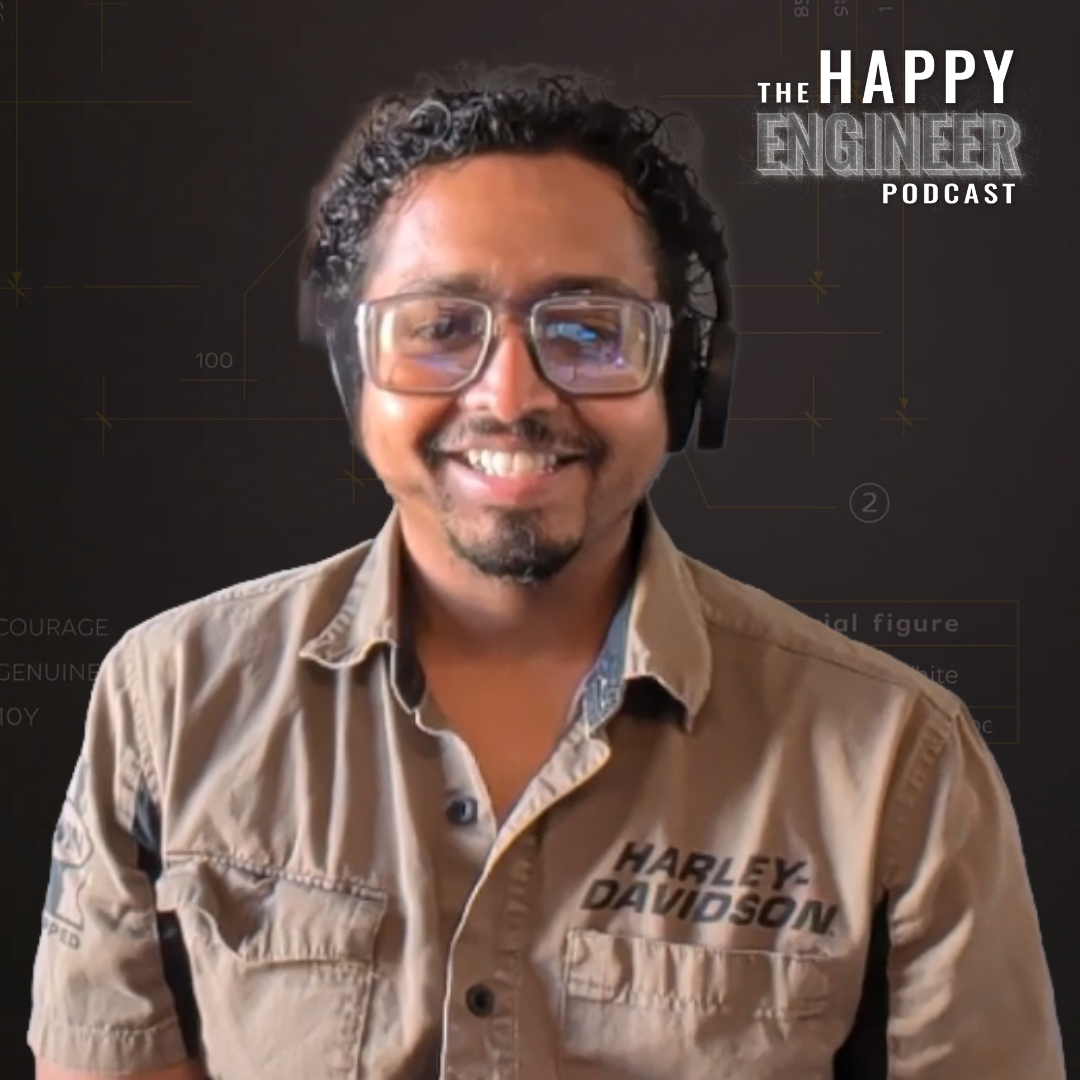
Pramit did the opposite. He’s a senior engineer on the software team at Harley-Davidson, and someone I’ve had the privilege of coaching. Before a recent town hall, the CEO walked up to him and said he expected Pramit to ask questions.
He built that reputation one raised hand at a time. It started with a squeaky first question and a lot of quiet hellos to VPs in the hallway.
He breaks down the networking script he says works 99% of the time, why he never prepares his town hall question in advance, and the one question about Sturgis that put his work in front of the CEO and the CTO.
You’re going to be in that room anyway. The only thing missing is the courage to raise your hand.
Press play. Then go sit in the front row.
The Happy Engineer Podcast
LISTEN NOW
What You’ll Learn
Your work has never spoken for itself
Pramit fills the wins section of his staff meeting with five or six items every week. Then he noticed something uncomfortable: he was celebrating everyone’s contributions except his own leadership. If you’re the reason something happened and nobody knows it, how would they?
Who else should be reading your update?
Pramit takes the same update he sends his boss and repackages it for someone in supply chain, a tech lead, a program manager. Then he asks them, “Is this language you understand?” You already write the update. The only question is how many people it reaches.
“I just finished three years. I feel like a baby here.”
That’s the opening line of the 10-minute networking script Pramit plans to keep using until he hits 20 years. And if you couldn’t care less about promotions, he has a reason for you too: the people you know are the ones who stop escalations from landing on your plate as surprises.
Stop preparing your town hall question
Pramit walks in with a frame instead of a script. Listen hard. Stay positive. Acknowledge what leadership shared. Get curious about the part that felt like a cliffhanger. One question about bringing his Sturgis learnings back to the business led to “Send me an email,” then “Copy the CTO,” then an internal article on his work.
What level have you decided is off-limits?
Pramit used to think he couldn’t talk to a chief engineer. So he started by saying hello to VPs. Just hello. For days. Then he started sitting up front, and his teammates started sitting next to him. Leaders go first, and the person who goes first gets seen as the leader. Which room is that for you?
About Pramit Baul
Pramit is a senior engineer on the software team at Harley-Davidson. He’s an IC who loves working with people, and his style shows it: solve a problem until it scales, hand it to the next person, and move on to the next challenge.
His entire career has been in specialty transportation, spanning motorcycles, boats, and semi-trucks. At Harley-Davidson, he represented the company at Sturgis, the largest motorcycle rally in the world, riding a bike there and back and talking directly with customers. This customer-centric approach to engineering career building sets Pramit apart and has been a big reason for his success.
Links & Resources
Watch next
Work with Zach — Book a free Career Growth Audit
Connect — Follow Zach White on LinkedIn
Connect with Pramit on LinkedIn
FULL EPISODE TRANSCRIPT:
Please note the full transcript is 90-95% accuracy. Reference the podcast audio to confirm exact quotations.
Zach: Wow. I just sat down with Pramit. He’s a senior engineer at Harley-Davidson, someone who I’ve had the privilege of coaching, and the most amazing thing happened to him. Before one of their company-wide town halls, the CEO walked up to Pramit and said…
Expand to Read Full Transcript
…I remember you from last time, and I’m expecting you to ask questions. Pramit’s not a VP. He’s not a director. He’s not even a manager. He’s an IC who earned that in the one meeting that most engineers skip to clean out their inbox. And today he breaks down exactly how he did it and how you can get noticed by executives at any level without adding hours to your week. So there’s 3 things in this conversation that you don’t wanna miss. Number one, how to stop hoping that your work will speak for itself and where to start speaking for it. Number 2, the networking script. That Premit says works 99% of the time to build useful relationships. And 3, his framework for asking that first question at a town hall, including why you should not prepare it ahead of time. If you’ve ever sat in a town hall, if you’ve sat in any meeting for that matter with a question or something that you wanted to say in your head and you let the moment pass, This one’s for you. Let’s do this. All right, Premit, welcome. So glad you’re here. I remember when we first met, our first conversation, we were talking about interview preparation, if I recall, and the theme was, how do you stop showing up at a level 15 out of 10 energy when the interviewer was at like a level 6 out of 10 energy? We had this conversation about Man, you are like bringing way too much heat into that room and how to match them and just take them up one notch. And had a great conversation. And from that very first time we ever coached together, it was obvious to me, for one, this guy is serious about growth. And for two, you ask great questions and are willing to change your way of leading and being to make the results happen. And I love that about you. So thanks for making time. to be here. And I think to set the stage, you gotta just put some context out there. What do you do? Where is your focus in engineering? You know, your passions and excitement when it comes to engineering and leadership. And take me back to your memories of before we first met. What was going on in your career then? Pramit: Well, yeah, first of all, Zach, thanks for having me. And the reason I’m looking incredulous is I am surprised you remember that, ’cause I probably asked you 300 questions in between and you had so many clients. Oh, at least. So yes, so I am currently a senior engineer at Harley-Davidson. I’m in the software team, and my whole career has really been around what I call specialty transportation. So that is motorcycles, that is boats, that is semi-trucks. Zach: Yeah. Pramit: And so I’ve just been around that world a lot. And Zach, like, before I met you, I was kind of in between trying to figure out what my next step is going to be. And I was doing a lot of these interviews. And what I remember from that really, Zach, is because I’d been seeing your videos a lot. And initially I just got a certain, you know, you think of a person a certain way when you see them online. So I was like, oh, this guy’s too good at talking. Like it’s too polished. And then when we spoke one-on-one, there was another layer to it where you were speaking to me more frankly. I was like, wow, how did he know that? And that’s when I got to know you a little better. You know, how we present ourselves online is a version of us, but then when you speak to them, it’s different and people know you at different levels. So that was a great thing in terms of just getting to know someone you think you know just because you saw their videos. Zach: Yeah. Specialty transportation. So, so let’s think back to A couple years ago, we’re first connecting, and I appreciate, you know, the depth of the relationship starts to grow. We start working together. What were the gaps then that you were looking to solve? And specifically around, you know, your reputation and your career vision and the things that you wanted to accomplish. Tell me a little bit about what you remember of how you saw things back then? Pramit: Back then, especially looking back now, I would say that a lot of my questions were around very specific issues in terms of navigating certain, uh, work relationships, navigating certain situations, uh, very much about, uh, yeah, it was very much about that me, I was I was new in the company. I wanted to prove myself. I still want to prove myself. I mean, that hasn’t changed, but a lot of it was fear-driven. And I was trying to figure out how to navigate a lot of those things is where we started. Zach: Tell me if this is true from your perspective. My memory was that we had very few conversations around technical challenges and do I have what it takes to deliver the results that are expected of me? It was a lot more of these, you know, relationships and creating the right experience with a leader or a skip, or, oh, I have this opportunity to be in the room with a VP. What should I do with it? I mean, always focused on the people side more than the technical side. Like, you had that really well handled, it seemed like. Does that feel true to you? Pramit: Yes, I would say more like, uh, no, I mean, I did, uh, I felt like that was the best use of our coaching as well in terms of the people side, because that’s how I like to do my work as well. I have been told I have a unique style of working, but essentially what I found is I’m an IC who loves to work with people, and that has been an interesting kind of thing to navigate around. But yes, uh, the way I found I work best is that I solve something where it is at a point where it’s scalable and I can delegate to the next person and then move on to the next thing. And with that, I found a lot of value working with people more, and which is why a lot of my problems or the things I brought or the opportunities I was getting was very people-focused for sure. Zach: So let’s double-click on the— what has really become an area of genius for you on the people side. Most senior engineers, most ICs are pretty quiet. They keep to themselves, they put their head down, they do their work, and they fall into the trap that I’ve talked about many times. I’ve talked about with you that your work does not speak for itself. You want it to. Other people who mean well will come along and mentor you and say, just do great work. Let your work speak for itself. That’s not how it works. People speak for your work. You speak on behalf of your work. And ideally, you’re getting other people then to speak on behalf of your work in those rooms that you can’t be in. And you have begun to master the art of speaking for your work and getting others to speak about your work in those rooms. So lay out how that works for you. How have you Shifted towards that? What are the tactics that you use? Let’s just sort of high-level lay it out what that looks like. And then we’re going to dive really deep into exactly how someone else who may want to build that skill can do it, but just kind of 20,000-foot view first, Pramit. How did you build that muscle? What are the different strategies you use? Pramit: One thing that really helps is it really starts from the staff meeting itself, the way you talk about your wins and every, And when we— yeah, I would say it starts at this, at your organization weekly meeting where you meet with all your team members, then up your org, then, and then further up and up. Because you, uh, what I’ve really done, which I found in retrospect, is that I speak up a lot in our staff meetings in general. I’m always there, always paying attention and just trying to be curious about what’s going on, whatever the downflow of information is and everyone else is doing. Yeah. I think really it starts It really starts at the weekly meeting and then it goes further along. So one thing I’ve gotten, one thing I’ve been doing here is really, you know, as you give out updates and reports, I’ve actually been finding more people to give the updates to. There were, uh, in terms of there are your general stakeholders you want to give your updates to, like say validation, you give it to system and then they take it and move forward, say. Uh, what I’ve also done is, so say if there’s a tech lead on the software side or if there’s someone on the program side I’ve also sent them what I would send my vertical, like, hey, what do you think of this? Is this language you understand? I send it to someone in supply chain. I’m like, is this understandable to you? Like, if I would send you an update, I would send it this way, but just learning to communicate at different levels using whatever you have already, just packaging it differently for different audiences and see if they understand that the work you do. And that really starts at whatever you’re pushing out every day. or sending to whoever you need to send to, whether that’s your boss or anyone else. How about you send it to someone else in your— Zach: Yeah, I love this. Pramit: Yeah. Zach: Okay, so 3 levels. Let’s hit all 3 and then we’ll come back to this. I mean, this is a great tactic already with just sharing updates, but the weekly staff meeting. So, a peer level and your boss becoming more intentional in that forum. Pramit: Yes. Zach: Then it’s like up and around the org chart. And, and, you know, email updates and other ways. And, and then it’s like to everybody. And we’ll talk about, you know, the, the gold standard of the town hall meeting and how to leverage that in a little bit. But, um, it sounds like what you’re describing is kind of in the middle of staff meetings slash, you know, up and around the org chart. Yeah. With sending updates, et cetera. So tell me if I got this right. If you’re working on a project and you hit a milestone or there’s, Maybe there’s a risk you need to share or something’s going on. You’re going to package and share that at the weekly staff meeting as an update, maybe ask for insight or just be clear with everybody about what’s going on. You’ll then take that same update, reword it or repackage it to share it with someone in supply chain, someone in the lab, someone else cross-functionally. Yes. And do you actually say in that note, hey, does this make sense to you? Hey, this is an update. Can you give me some feedback? Like if this is clear or how is that actually coming across? Pramit: Good question. So yeah, part of this is that where I work right now, it’s very much everyone’s there all the time. And I’ve done a good job of trying to get to know everyone. So anyone I send an update to already knows me by name, or I’ve said hi to them 10, 15 times, or I’ve, pass by their desk and just talking. So a lot of the comfort that comes from me sharing my work is I have built those every day. I’ll give you an example. Like, as I’m going from— as I’m going from the parking lot to the desk, sometimes I’ll take a different route to my desk just to see different people. And if there’s something interesting going on, I just say, hey, what are you doing? What are you working on? And some conversations start there. Uh, but exactly, a lot of it goes back to when you talk about just looking people in the eye and just saying hi. And that is every single time you say that consistently builds the confidence for you to share more. So a lot of that starts as part of my day. It wasn’t something that was intentional. I just like saying hi to people. I’m friendly that way. And I’ve always heard before you bring something to someone, make sure you get to know them. So that’s something I’ve always done. So by the time I was sending them an update or something, it was someone I knew I’d met at the office gym. I mean, that was just part of it. Zach: So, Pramit, if someone just doesn’t share that personality trait and they’re hearing you describe this and they’re thinking, there’s no way that I’m taking the long way to my desk to just go randomly walk up to some other person. and say hi. That’s just not me. Or maybe they work remotely. There is no walking by. You know, they actually just walk into their office in the morning, turn on the laptop, and get to work. So they don’t have that opportunity. If you were going to explain why you should do it anyway, like, why is this important enough, whether it’s not your personality or you need to put extra effort because you’re working from home or what? Pramit: Yep. Zach: What would your like number one or top couple of reasons be why, look, you got to make this happen in terms of building the relationships? Pramit: Well, I would tell them that I can give you the script that has worked for me 99% of the time in terms of building relationships and building relationships on teams, by the way. So, um, it’s super complicated, but I’ll slow it down. Hey, I am person X. I’ve been in the company for Y number of years. Can I get 10 minutes on your calendar sometime this week or next to get to— and the key is— Zach: I love this setup about how hard this is going to be. Say that one more time. Here’s the intro. Pramit: Yes. So, hi, my name is, my name is Pramit. I’ve been in the company for 3 years and I’ve been saying this as like, I just joined the company. I’ve been my first 3 months. I just hit my first year. I’m going to keep saying this till I hit 10, 15, 20 years. Like, hey, I just— Yeah, just use the new guy energy, but just be like, I just finished 3 years. I feel like a baby here. Right. So when I say, hey, I’ve just been here, I just finished 3 years, heard about you through someone else. Can I get 10 minutes on your calendar to get acquainted? Sometimes. Zach: I love that. I love that. And I will add, if someone’s doubtful that those 10 minutes have a return on time invested, Not too long ago, I recorded an entire episode of the Happy Engineer podcast just explaining that your next promotion, your results in your career are not just about your results. It is about results multiplied by reach. That is your reputation. Results times reach. I’ll put that episode in the description. Go watch that after this, but without the reach, Without those people to see and know and cheer for and, you know, multiply the results, you do not have a reputation. So, Pramit, I love this. You’re, you’re getting to know people. Back to these tactics then, where are the results being shared? How are you building that reputation? Pramit: Hmm. Zach: Uh, you’re sending updates. Yeah. You’re repackaging. What else is happening in that staff meeting? Can you go back to that really quick? Is there any other tactic that you can share with us on how you build your reputation in staff meetings? Pramit: Uh, I’d say, uh, for staff meetings, the big thing has been just contributing consistently. And there is a section where we are encouraged to put our wins. I just make sure to have 5 or 6 wins that I write down, whether that’s me, whether that’s another colleague, whether that’s something we work together on, I fill it up. Yes. So that itself gets a lot of things going. Uh, and that can just be me recognizing someone, that can be me working with someone. What I realized recently, Zach, which is interesting, that I’ve been putting a lot of wins where I didn’t credit myself. And I realized that, okay, it’s good that you’re sharing other people’s wins, but also share that you led this. Sometimes if someone else quote unquote does the work, right? Like— Zach: That’s true. Pramit: You don’t necessarily take the contribution for the leadership, but you also know that without your input, it wouldn’t have happened. So those get— those have been interesting in terms of framing, taking the credit for what I do, but also celebrating others. Zach: I love that. Yeah, I love that. And if somebody’s like, oh, we don’t do wins in our staff meeting, just ask. Tell your leader, hey, we would— this would be a great thing to add. Can I bring wins and celebrate the team, celebrate what’s going on, you know, in the next staff meeting? Just make it happen. Don’t let your boss’s agenda be the excuse for why you’re not leveraging these Tactics. That’s good. I cut you off from it. What else did you want to add there? Pramit: Oh, going back to your question, the thing about if someone’s skeptical about reaching out to people and everything, what I will also say is if you just want to make your life easier, like forget about promotions and stuff. If you’re like, just, I just want to work and get things done, uh, you’re more likely yourself to do something for someone who you know better. Zach: So Pramit: if you just want to sit down and do your work, the best way to do it is like many people know about what you’re doing. And what happens in return is you tend to get less surprises. When something happens, you can just talk to the per— you can talk to a lot of people, or you just know what’s going on, know the pulse of the organization a little better. Zach: Yes. Pramit: So you’re not, you’re not taken aback by sudden escalations as much. Like something’s going to happen, but you can join the dots and understand why certain things happen instead of just dropping on your plate. Zach: So it’s really good. Pramit: It just makes life easier if, even if you don’t want to go the whole, do all of that. Zach: Yep. Yep. I had the same experience at Whirlpool when I worked there too. You get the benefit on both sides. All right. So weekly staff, people at your level, cross-functional partners, project team members, those, those all make sense. And a lot of people would say, yeah, I’m comfortable. Pramit: Yep. Zach: Doing that, or I, you know, I could stretch out of my comfort zone to do that. But now let’s take it to, to the big leagues. You know, when you want to get those results in front of the CEO, the VPs, the, the directors, the folks that you normally don’t have access to, and the town hall meeting, the place where most people just feel like it’s a waste of time. I just, I don’t even want to go, right? I want to go do work. I’d rather be cleaning out my email inbox than going to these updates where it’s, you know, information doesn’t matter. And you’ve found a way to leverage the tactics we’ve, we’ve coached around in these, you know, your own passion for asking questions into big wins in town halls. So tell me when that began. Pramit: Right. So yeah, I, uh, and the bottom line up front really is that right now I have a good reputation of asking the first question in town halls. I’ve actually gotten to know people who know me because of the questions I’ve asked. That’s the background here. Done it in a few CEO town halls. Very, very proud of that because that was a huge leap of courage. Where that started is I will say our company has a great culture of debate and town halls in general. So like software will have a town hall, engineering will have a town hall, and it goes up the chain. And so that culture is built within leadership to have a town hall, talk about what’s going on, and just have a very open dialogue. And I really got my reps in from the engineering town halls where our leader, when they’d ask questions, I’d be the first person to ask something. And that’s where I got my reps in from. That was one. 2 was At some, I would say from my last company. Yeah. Uh, not last company. I’d say I started to realize that if I want to have a bigger impact, I first need to be able to be okay with the concept that I can have a conversation with the VP or the GM. Mm-hmm. Uh, I think growing up in my career, there was some point I’m like, uh, where I was like chief engineer. Oh, I can’t talk to the chief engineer. when I was younger. Right. And you put these blocks in your head. Oh, I can’t talk to this person. Like, whatever am I even going to say? Zach: Yeah. Who am I to ask a question of the chief engineer? Oh, this is— I’m just fill in the blank. Pramit: And I was also terrified of talking to the VPs and GMs of my company. Don’t get me wrong. Just because, right. Uh, what I did really was I For days, I just said hi to them. No, no, not even like, hi, my name is this, nice to meet you. Just hello. And just that rep, because like even that, even saying that was scary. Like, oh, I just said that. I just said hi and I walked by. Zach: Yeah. Yeah. I just opened my mouth Pramit: in Zach: front of the VP. Pramit: Yeah. Zach: Yeah. Pramit: No, Zach: I appreciate you being honest about this. Like, it’s not like you just rolled out of bed one day and walking into a conference room with an executive level leader at Harley-Davidson was no big deal. Like you, you did. Build your confidence up little by little. I think that’s important for folks to hear. Just start saying hi. Make eye contact with them in the hallway or in the cafeteria instead of putting your head down and walking by like they’re not even there. Start with the next step available to you, you know, if you’re not ready to do the bigger step. But do you remember the first question you ever asked then? Can you, like, if you go back to those early town halls when you finally had the courage to step out and ask the first question, Do you have any memory of like those first couple of questions you asked? Pramit: Uh, I’ll say that the first few town halls I was observing, first of all, and I realized one thing is that the town hall is also a great place for if there’s certain things you need to bring up and there’s certain things you want to bring visibility to, that’s a great place to do it. And during that time, I was also learning how to ask good questions to leadership in general, because What I didn’t want to do is bring a complaint up in a town hall. And mainly the reason was that if I wanted some— if there’s something going on wrong or something, I feel like the town hall wouldn’t be the best place to do it. Because what I saw is that the leadership got some very like upfront questions about what’s going on with this, what’s the status with this. Zach: Yeah. Pramit: And they were brave enough to take every question head on. And I’m like, okay, if I’m gonna bring in a question, I want to bring some positivity into it. We all know what’s going on. We all know what we’re struggling with. Not— I don’t need to add anything to it. Right. So the first thing I decided is that I’m going to keep it positive. I’m going to keep it something that everyone can relate to. That was kind of the mindset going in. Zach: Yes. I love that. I love that. There’s already somebody who’s going to ask about, will there be any more layoffs or what are we doing about Yeah. XYZ issue. What if I came in and asked a question about something good? Ask a question with a positive spin, set a different energetic tone in that room. I love that. Keep going. Pramit: Right. Yeah. The thing is, I don’t remember the first few questions because it doesn’t even have to do with the question really. It’s more the frame. Uh, so let me go through that. The first thing is like the specific question itself you ask. Doesn’t matter. In fact, you shouldn’t have a question prepared for a town hall is what I would tell you. What you should be prepared to do is to be listened to, to be positive, and ask something that is relevant to you but also has a larger discussion in mind. And that’s something the leaders would be happy to answer. Like, they’re all— like, in a town hall, they’re already under the gun. Like, they’re going to be asked some hard questions. And yes, you can ask something you feel, if that’s something you really feel, or you can get a discussion going. Zach: Yeah. Pramit: That’s on you. So really the framing has been that I’m gonna be positive, I’m gonna— it’s gonna be something that I’m really curious about. And third is I’m listening very intently during the town hall. I’m taking notes, I’m writing down things, I’m seeing what people are talking about, where the pauses are. So my questions really come from The content of the town hall. So if there’s a certain emotion like joy, or if there’s a certain product that’s been focused on, and that’s something I work on, that’s kind of what I frame it on. So really the framing, because I’d love to tell you about the framing, is acknowledging that they did something to stuff. Like town halls are hard because you have to take time out of your day. You prepare this huge presentation. You’re going to talk to everyone, like the whole company, you know, they’re going to ask questions because we’re all curious and we have a culture of just being open with each other. Zach: Right. Pramit: Yes. And so you’re going to be, uh, yeah, you’re going to listen. You’re going to be positive. You’re going to have a good mindset about it and you’re going to see what was going on, what the room is like. And there, the question frame, which I’ve just learned from you and Brandon, my speech. Coach, uh, is that you start off by acknowledging the town hall, what happened, what you really liked. And the best questions are the ones that are curiosity-driven, that can result in a longer discussion. That can be like if a part of the town hall was a bit of a cliffhanger, you just wanted to know a little bit more about that. Zach: Okay. Pramit: Yeah. Zach: So, so let’s set up a specific example, especially if somebody is nervous about like, oh, well, If I don’t know the question in advance, then I may not think of one. I’m going to miss the opportunity. So let’s like go to one of your more recent examples and just tell us what that would actually look like. You know, town hall ended, you grab the mic, you’re going to ask the first question. What are you saying? And then break it down to kind of the building blocks of how that came together. Pramit: Right. Um, because, uh, yes. So, uh, on the most recent town halls, we were talking about Say one of the biggest rallies we’ve done. I’d just come back from Sturgis and I was kind of— and I had come back from Sturgis and had a lot of thoughts in my head. And I really asked the CEO like, hey, CEO Ari, like I have a lot of things going in my head. I’ve just learned so much. How do I translate this to actionable business insights? Because what happens is you go to an expo, you go to a convention, you learn all these things and they’re like, wow, this is amazing. And then when you come back, you know, life goes on, your projects go on, and the stuff that you learned starts diminishing in value. And some of it might carry forward, some of it doesn’t. So especially like, for context, Sturgis is the largest motorcycle rally in the world. I had the opportunity to rep Harley there, took a bike back and forth, talked to about— talked to a bunch of customers, learned a lot. And I was like, I want to bring this back. How do I bring this back? while still getting everything done, right? And in the framework of everything. And so I asked Adi, like, there’s so much in my head, what do I do? And he just said, send me an email. And I was stunned because this is many, many, many levels above me. And I’m like, what’s the format for sending a CEO an email? Zach: Okay, let’s pause for just a second. So You took on this unique development experience of going to Sturgis. And, you know, maybe in every company, in every industry, there’s a similar thing. You do a week-long training on Six Sigma or operational excellence or get your black belt. Maybe it’s go to Sturgis, maybe it’s go to, uh, you know, the Consumer Electronics Show out in Vegas, whatever it is. And instead of letting all that excitement and energy and knowledge just slowly decompose on the shelf, so to speak. You asked the CEO of the organization, how do I bring all this energy, this excitement, this learning back to my role, to the company in a positive way, in front of everybody in a town hall setting? That’s what happened. Pramit: Yes. Zach: So the reputation is already in place that you’re gonna be there, you’re gonna ask a great question. The CEO recognizes you and can call you out by name. How many senior engineers at any Fortune 500 organization are known by name by the CEO, right? That’s a small number of people. And the effort required to create that result is the courage to ask a question in a few town halls in a row. Pramit: Mm-hmm. Zach: Like, just to sit on the weight of that. When you think of return on time, like, you’re going to be at the town hall anyway. Most of the time it’s mandatory to be there. Your boss wants you there. You’re going to be sitting there. You’re going to be sitting through the Q&A anyway. So like, there’s no extra time invested. All it takes is the courage to ask. Pramit: A lot of ICs will actually not sit in on the town hall, so they likely have it playing while they’re doing their laptop work and stuff. Because it is hard to make time for town halls also, because if there’s a project deadline that was right after town hall, there’s Zach: always something Pramit: more important, always something more important. So, and if you’re like, okay, this is just news about the company, I’ll watch the recording. There’s a million reasons why you wouldn’t want to go to town hall. It’s like, okay, I have to deliver this. It has to go out the door. Somebody wants it now. That’s just news. Like, And there’s all these stories. So that’s one. 2 is, uh, the asking questions part is actually when I— now there are many parts to it, or maybe I overcomplicated, but the first thing is, A, that you are okay saying or projecting your voice in a crowd. Because if you think you won’t be heard, you don’t think your question’s important, then you have to battle all of that as well. The third one is doing this. Zach: Because the first time you do this, for those who might just be listening, that’s the hand raise. The hand is going up. Pramit: So doing the hand raise is also scary because I remember the first few times I did it, I was like, and then they saw my hand. I was like, oh, they saw my hand. Uh, Zach: I can’t take it back. Pramit: Part of it is also the reps of those. Like, if you don’t feel comfortable asking the question, I wouldn’t downplay how scary it is. Uh, but like just writing down the question you would have asked and reciting it in your head is a rep. Because for— of course it is a big lift to be able to do that in front of people, because then you have to be a little— yeah, you have to be comfortable with that. But if you’re not, I recognize that that’s hard because I’ve had people come up to me later and they said, like, they were pretty amazed that I was able to ask the question. And I just told them like, yes, part of it is being okay with the fact that you can talk to someone, you can talk to the CEO. And that’s a big mindset shift. Like, and that’s hard. Zach: It is. I appreciate that reminder. It’s easy for me, you know, now doing what I do and the people who I get to coach to forget what it was like the first time I was a junior engineer sitting in a town hall and that, you know, open window for questions came and went and I didn’t ask one. There’s more to it than meets the eye. I think you’re right. It’s good to respect that. I love this exercise you offered. If somebody’s just not ready, not willing to ask a question in their next town hall, go through the mental visualization, the mental rehearsal. Pramit: Yeah. Zach: Here’s a question that I would want to ask. Think about it. Imagine asking it. Articulate it in your own mind while you’re sitting there. as if you were gonna ask it. And that gets us one step closer. Count that as a rep. I like that. Anybody can do that. Pramit: Another rep is being comfortable sitting up front. Like in my head, I’m like, okay, the first 3 rows are for senior leadership. I’ll just have it in my head. You know, whenever you go to a thing, the top row is probably for someone super, super important. So you might sit a little back and that’s up to you to decide what that line is. And maybe there are reservations, but try to be comfortable sitting up front. is also a rep. Because if there’s so many people and you’re just going to sit up in front, you have to convince yourself it’s okay to sit up front because you might not be okay with that. You’re like, I just want to hang out in the back. I shouldn’t be— like the should word, right? I shouldn’t be sitting up front in the first place. Even that itself is a rep. What I found is, Zach, that once I started sitting up front, because I— something I just do, I found my teammates starting sitting in the same row as me. They wouldn’t do that before. Zach: Yep. So Pramit: they’ve gotten comfortable just sitting in the front, which they wouldn’t have done before. I know that. So that’s there. Zach: And now you have the entire leadership team seeing that shift. And guess who’s labeled as the leader, the one who gets the reputation boost from that change? It’s the person who went first. Leaders go first. So we got here. Talking about work doesn’t speak for itself. We speak on behalf of our work, getting more courageous, more confident to give updates in staff meetings, to send updates across the organization, to walk the long way to your desk, talk to people, build reach, build relationships, and then leverage this totally underutilized opportunity that exists in our companies of the town hall. To build your reputation, to ask a positive question, to sit up front. Pramit, let’s talk a little bit more about how the Sturgis experience and asking that question has led to some open doors for you. So this began with mental rehearsal of your first question and the courage to just raise your hand. Tell us what’s happening now that you’ve been building this muscle and getting these reps. Where has it taken you? Pramit: Oh, so a lot of the town hall, um, oh yeah, a lot of the town hall, it continues after the town hall. So if you remember, if you, any of you listening to this, you remember any town hall of yours where somebody asked a question, what actually, what also happens is if it’s a question that’s discussed, people come up to you after that and they ask you follow-up things or they offer you things in terms of like, hey, you can try this. Um, and what the— a big value I’ve found is just people coming up to me and having follow-up conversations with me on this. Because if you ask something in a positive way and you just want to have a conversation and you’re curious, there are people in that town hall who had the same question who may not have wanted to do it right then for whatever reason, but now that you’ve started that, It starts the conversation, whether that’s in the chat of the town hall or within, or within the building, that energy is out there now. So people start discussing it. So there is an aftermath, like a positive aftermath in terms of you asking the question and then people continuing to build that conversation on. That’s one. The positive thing I have really found more recently is that the all the work I had done in terms of talking to customers and everything, that actually got published internally in an article inside the— inside Harley-Davidson. And then I was able to share it with everyone as well. Um, but that was one goal of mine, to be published internally for work I did. And that was something I was really happy about. But that really came about because, um, he told me to send him an email and I do. And I didn’t know what to do, but I just stayed up till I finished all my work, what I had to do, all my core roles. Then I went at night, then I wrote up this email that I went to the CEO and he also said, oh, by the way, copy the CTO on this. I’m like, okay, cool. Zach: Yes. Pramit: And the next thing I know is that the communication team is getting looped in and then they’re going to publish something. So, and I saw that. And now if I ever want to tell people about my experience inside the company, I just share the article instead because right now it’s there. Yeah. Zach: So good. Pramit: Yep. Zach: So good. I remember I was a lead engineer at Whirlpool Corporation, and I asked a question in a town hall. And I don’t remember all the details either of exactly what I asked, but same sort of thing. We talked about product aesthetics and a lot of the work that was going into the look of appliances and how that was becoming more and more important. And I asked a question around that, just positive and passionate. The new senior vice president of the global product organization had a couple minutes to respond, but the question just happened to land, you know, in an area that was very important to him. Mm-hmm. He wanted to go deeper. And I got a call later that afternoon from the corporate communications vice president that the SVP wanted a 15-minute one-on-one with me the next morning. to share with me more about his vision for product aesthetics and basically expand on his answer, ’cause he felt like he wasn’t able to do justice to it in front of the town hall. And then they used that conversation that we had as the basis of some further communication to the entire organization. And so it’s the same thing, like you just never know. And the bottom line there was, yeah, I had no idea what to expect, But just the courage to raise your hand can create those open doors. And from it, I don’t even remember the 15 minutes. To your point, I mean, I was probably freaking out and certainly could have handled that conversation even better. But what’s amazing is I didn’t have to do anything special to make it great because he wanted to talk to me, right? So all I did was come with a couple other questions and I just sat there and basically listened to him for 12 minutes. But that’s all that happened. But— For the rest of my career, anytime I walked by him, handshake, hello, looked him in the eye, knew me by name. You know, we were connected from that point forward. And so, you know, is that the single thing that expanded and ex— you know, helped my career grow? No, of course there were lots of other inputs. But the point is, when you think as an IC, as a manager, as a director, what else do I need to do to build my career, to accelerate my career? And if you only look at results, working more, working harder, doing better, being smarter, somehow competing with everybody else in just that domain on results, that’s a hard, hard game to win when, man, just one or two of these strategies in reach can make all the difference. And the higher you go, the more important it becomes. And so I just appreciate you sharing your story. And I think— We should be honest and address this real challenge that engineers face. You know, introverts, maybe more shy by personality, don’t have the courage to raise their hand, et cetera. So if you were gonna offer one or two more, like the simplest steps, the smallest steps for somebody who wants to follow in your footsteps, but feels like it’s out of reach for them, it’s, it’s, it’s too big of a, of a step. What would you offer? Like, what’s the easiest way to begin? When it comes to building courage and building that reach and reputation? Pramit: Honestly, with— if you are— if you don’t feel confident, if you don’t feel you have the courage, I’d say you are right in the sense that courage is built. That in the sense it starts with, A, you being okay with actually doing it. Because if you feel that you can never talk to someone higher up then you’ll never ask that question. So I think it really starts with, first of all, if you don’t feel comfortable talking— it’s levels, right? Do you feel comfortable talking to a manager, a chief, a skip, a GM? Which level do you think is unattainable? And starting to do some one-on-ones around that, really. Now, coming to the town hall, the first person, the person who goes first, it’s the hardest one to do. So be the second or third person or ask the other reps. You can do is ask it in the chat. Also a quick tip, your first town hall question may sound squeaky. At least mine did. Because as I was saying it, first person in this room— Zach: You’ve given us permission to squeak it out. Pramit: Yeah. Cause I realized like, oh wait, they saw me. Oh wait, I’m going to say words now. Oh wait, I have to enunciate things and I got to get this right. You know what Zach: I’m hearing though, Premit, as you talk through this? Pramit: Yeah. Zach: Maybe the first thing for somebody who’s lacking the courage to do this on their own is to just find the Premit of their organization and go sit by them. Pramit: Yes. Zach: Proximity is power. We talk about that in our coaching all the time. You know, if you want to make a change, get in proximity to people who are already living that change. So maybe step 1, if you’re just struggling to take any action on this is find the closest version in your team to Pramit and just start hanging out with that person more. Would you say that’s— Pramit: Yes. Zach: A factor? Pramit: And yes, another thing I’d say there is that part of it is just being okay with asking for help there, right? Because what happens is when someone has qualities that we don’t have, you might think, oh, he’s just that way. Or, you know, you might think, you might paint them in a certain way. We tend to sometimes caricature are the people we work with in terms of thinking of them as complex human beings. So yes, the first thing would be to go hang out with them, but also to tell yourself, this is— there is something I can learn from this person. So I’m going to do it. I’m going to tell them like, hey, can you teach me this? Because that is hard to do. Zach: Love that. Pranav, you have taken that advice of asking people for help Very directly in your own career. I know that you have multiple coaches. I’m one of them. What would you say coaching has brought into your career growth that you wouldn’t have had without it? Pramit: I can’t imagine the career I’ve had, would have had without it. But what I’ve really learned from coaches is that sometimes a coach might— that if you want to learn something and you trust someone, you do the thing they ask you to do. Now, let me preface that. Um, for example, I remember that one time— I’ll give you 2 examples, one from you, one from Nader as well. One time I was trying to get hold of a recruiter and we were sending multiple follow-up emails, nothing was working. And Nader told me, yeah, just, hey, public— why don’t you send him a kudos on LinkedIn about the great job he’s doing? You just acknowledge him on LinkedIn. I’m like, I was like, Nader, I don’t understand what is going on. But I’m going to do it because I trust you. And I did it and it worked. And that’s the reason I got, got my job after layoffs, uh, back in ’21. Uh, then coming to you, Zach, I remember that you had told me that it’s okay to confront people at work or have a one-on-one conversation, which I was very good at doing with personally, with friends and family. I just thought work is a line. You never confront anyone. You just like don’t do that. And I think at the end of it, I was like, I don’t think it’s gonna work, but whatever, I’m gonna try this thing because you have said the right combination of words to get me to do this. And I did it and it felt much better. I was like, oh, oh wow. So throughout my career, if I wanted to talk to someone one-on-one and just have an honest conversation about this, I could have. So it just unlocks new things for you. But you really— but for this to work And if you’re working with a coach, you really gotta trust the thing that they ask you to do. And that’s tricky because, you know, you have— you’re your own person and you want to do your thing. But if you are investing in someone to teach you a thing, you got to be invested in learning the thing. Zach: I think what you’re describing is really important because I get asked all the time, Pramit, you know, hey Zach, yeah, I see, you know, People like Pramit who got results working with you, or, you know, the 300 others, whatever, cool. You’ve got all these testimonials, but classic engineer question, you know, will it work for me? How do I know? How can I be certain that coaching will have the same benefit for me that it had for Pramit? And I think what you’re describing is the answer to that question. You are coachable. You are open to the learning. You are quick to take action. You have chosen to place trust in that coach. And you and I both have probably had times where that didn’t yield exactly the result you wanted, but on the whole, by doing that, and of course choosing great coaches, I’m with you. I could not recognize my life without my coaches. There’s no chance that I’m sitting here living this life, enjoying the things I enjoy today, Without them, I couldn’t even imagine the path I would have taken without them. And so I know you have many in your in your path as well, and many to come. And that’s that’s awesome. Pramit: Oh, and also, Zach, I have asked that question to Nader. I remember like, can you give like early on? Now that I say it, it kind kind of sounds silly, but like, hey, is there a guarantee that I’ll get a job? And I remember Nader saying that, hey, Pramit, if anyone gives you a guarantee, then you’re guaranteed to fail in the sense that. There is no guarantee as such. Zach: Yeah. Pramit: And I, I had that conversation with Nadir, like, how do I know this is gonna work? And the answer was, you don’t. You don’t. Zach: Hence why courage is a part of it. Pramit, this has been awesome. Super useful, super tactical. Yes, courage is demanded. Anybody can do this though. There’s nothing that you have shared today that any engineer on the planet could not replicate in their own way. in alignment with their own values. They may not do it the same way you do it, but these tactics are not only for the extroverts. They’re not only for the primates out there. These are things anybody can do. So I appreciate that. And if somebody needs more understanding of why this works, go back and watch the other episodes I’ll put in the description. Understanding your reputation, understanding tactics like the ninja brag. Put these pieces together to increase your visibility. It’s just worth it. It’s worth it. It’s the best return on time invested you can have when you’re already putting in so much effort on driving results. Parama, do you have any final nuggets of wisdom you want to share before we wrap here? Pramit: Having an intention. I’d say this has really worked well for me in meetings in general, but if you’re going to go into a town hall, have one intention. The intention isn’t like, let me figure out what’s going on. Is it— are you going to listen to the whole thing intently? Are you going to sit in the front? Are you going to think of a question? But have one intention. And it doesn’t have to be, I want to ask a question. Maybe you want to do something else. Maybe there is one particular thing you want to dive deeper into. Or the intention can be— Awesome. Yeah, but set the intention. When you go into these large gatherings, it’s always good to set an intention for yourself. Otherwise, you’re just going to be consuming information. Zach: There you go. First action, immediately set an intention. And our intention for you, Happy Engineer, if you stayed with us this long, is that this conversation would not just be information that lives in your head, that you will set that intention, that you will take action, that you will go build your career, that you will get incredible results and then pay it forward to the next person who’s following along in your footsteps. Pramit, thanks again for being here, man. You’re the best. Pramit: Yeah. Thanks, Zach. Appreciate it.